Sunday, 27 June 2010

Experiencing Beauty Amidst Conflict

After a long train to Frankfurt and flight to Athens, my friends and I arrived exhausted at six in the morning to the port, Paereus, ready to explore the island, Santorini and all of its beauty. However, arriving to the port we realized that boarding the high speed ferry to Santorini may not be an option. A line of about 20 protestors blocked the ramp to the ferry and despite the hundreds of travelers that held their tickets in hand and waited to board the ferry, the protestors successfully prevented any ferries from leaving the port that day. The groups of protestors were composed of men and women of all ages and they held signs and chanted rhythmically in Greek. At times, heated verbal and physical conflict would erupt between locals and protestors. My friends and I decided to tour Athens for the day and return to the port in the morning. Shouts could be heardfrom our hostel throughout the day and the protest lasted fifteen hours at the port.

Strikes in Athens were sparked by an announcement made months ago by the Greek Prime Minister, George Papandrea. His announcement included the new measures that he and his government issued to cut Greece's deficit and "abide by the conditions of joint EU IMF bailout". (http://www.petergreenberg.com/2010/05/05/deadly-riots-strike-in-greece-athens-in-chaos/) Thus, Greece would potentially need to be aided outside of the European union or in addition to the International Monetary fund as opposed to receiving aid only internally. According to news reports, the decisions

made by the Prime Minister has resulted in significant wage cuts along with a three-year pension freeze for all public workers along with increased taxation on select products. Peter Green discusses the o

verall sentiment of Athens workers in his report on the strikes, suggesting that "ordinary people are being made to pay for the crisis." Furthermore, the European Union is experiencing great pressure as a result of the policies concerning cohesion and convergence that now relate specifically to Greece's current state.

A great paradox unfolds from all of the politics and regional and international tension that is associated with the unrest in Athens. Greek Prime Minister stated an increase in the tourism industry as one of his goals for the country. However, the British Foreign office issued a travel warning to Britons and furthermore, three bank employees

have been killed in Athens and four buildin

gs were burnt to the ground in this capital city of Greece. Thus, an increasing wariness of traveling to Greece has largely hurt its tourist industry and thus its economy, making the effort of the strikers a contribution to the further disintegrating economy of Greece.

IMF Statement regarding Greece

BBC Question & Answer regarding Greece in Debt and its future

After arriving safely to Santorini I literally caught my breath stepping off of the ferry as I was surrounded by sparkling blue water and whitewashed houses built into the hillsides. The entire weekend

felt like a dream and the scenery was so surreal I honestly felt like I was I was watching a movie or

someone else's life. Tourism in Greece makes up 17-18% of the country's GDP and it employs more than 850,000 people. (Informational page about the geography of Santorini) Each delicious seafood restaurant where we ate offered menus that were only listed in Greek and in English. Road signs were listed in English and ATM banks also only offered services in Greek and

in English. It was immediately clear that Santorini directed its tourist services to English speaking travelers. While in Santorini, my friends and I had the time of our lives. We rented ATVs to travel around the island and saw the different beaches that had different colors of sand as a result of the volcano, we rode donkeys up a cliff overlooking the Mediterranean, watched the most famous sunset in the world at Oia and ate delicious fresh seafood and Greek salad.


I kept thinking to myself, while in Santorini, about the strikes and their devastating effects on the Greek economy. It seems like such an immense tragedy given that the natural geography of the country attracts its tourists and that the country

along with the European Union are struggling right now due to its current political and economic state. Witnessing the strikes in Athens firsthand and then experiencing all of the wonders that Greece has to offer, truly opened my eyes to how interconnected Euro-Zone countries essentially are, despite their cultural, economic and geographical differences.

Changing Tourism at Buckingham Palace


I listened carefully as I could hear drums beating from beyond the mall. The mass crowds of peoples’ ears pointed upwards and the loud roar from the crowd emerged into quiet whispers. The drumming continued to get louder and louder, and finally I could see the Queen’s Guard contingent slowly walking from St. James’s Palace, off The Mall on Malborough Road beating their drums and walking as though they were mannequin like figures with stern expressions across their faces. Over the large crowds of people surrounding the railings at the Victoria Monument, I caught a glimpse of the large bearskin hats that are the stereotypical feature of the British guard. As I stood in front of Buckingham Palace I was awestruck at its majesty and eagerly waited the changing of the guard, one of the greatest traditions of England’s royalty. As the daily ceremony commenced, I could not help but notice the reverence of the assembly and the countless faces amongst us. So many people had come to witness this traditional English ceremony and it made me think about how England’s historical past had become a tourist attraction.

The procedure of the ceremony begins at St. James’s Palace, situated off of The Mall in Marlborough Road. A detachment of the ‘Old Guard’ forms up there in Friary Court at 11:00 am for an inspection by the Captain of The Queen’s Guard. This contingent then makes its way down The Mall towards Buckingham Palace at approximately 11:15 am preceded by a Regimental Band or Corps of Drums. The other half of the Old Guard is already on duty at Buckingham Palace and is inspected while awaiting the arrival of the St. James’s Palace detachment. The St. James’s detachment enters the Palace Forecourt through the South Center Gate and takes up position beside the Buckingham Palace detachment on the left hand side of the forecourt. Now complete, the Old Guard awaits the arrival of the incoming ‘New Guard’ from Wellington Barracks situated at the Buckingham Palace end of Birdcage Walk. (http://www.trooping-the-colour.co.uk/mounting/index.htm)

The changing of the Guard at Buckingham Palace, or more formerly known as Guard Mounting, is a popular London tourist attraction, close to the main London hotels, drawing thousands of visitors to Buckingham Palace to watch. The changing of the guard takes place in the courtyard of Buckingham Palace and is free to anyone to watch daily. The easy access to the ceremony makes it a desirable for London visitors and is also conveniently affordable. Tourist attractions like the changing of the guard mark a new era of tourism in the last decade of the 20th century (Ostergren and Rice, Ch. 11).

Traditional mass tourism in Europe was always to beaches or the mountains, yet a new variety of tourism has emerged. This new abundance in traveling stems from an emerging consumer preference for something different then traditional packaged European tourism. The demand today is more flexible travel arrangements and is being met by revolutionary changes in European transportation. As I traveled to London, I was able to take an easy Jet that is advertised for 69 euro’s roundtrip. The implementation of trains, buses, and advanced infrastructure also allow easily accessible transportation that caters to those wanting to see the main attractions of a city. Today, the preservation of historical buildings and landscapes is a relatively recent phenomenon. Upholding and maintaining these historical buildings and monuments allows for cities to develop these sites as main tourist attractions. As I visited Buckingham Palace and witness the Mounting of the Guard, I could see the historic nationalism present in the royal family and the traditional meaning of the ceremony, but the large crowds of people allowed me to witness the affects of changing tourism.

Monday, 21 June 2010

Vienna: Horses, Horses and More Horses


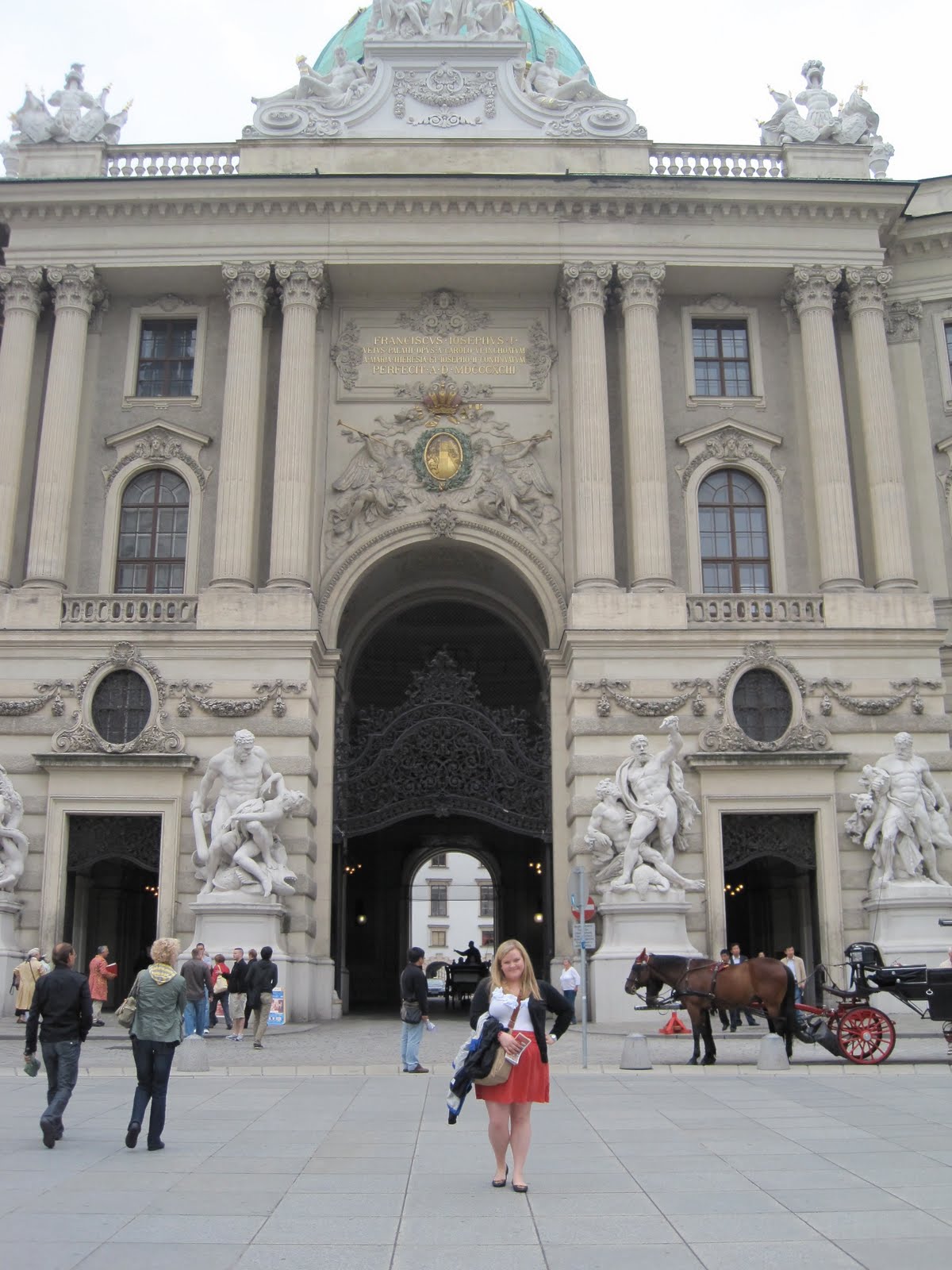
In Vienna, Austria, I went to the Spanish Riding School which has been a Mecca for riders all around the world. For me it was no different, from the time I walked down the street I could immediately pick out the magnificent building that has housed centuries of tradition and passion for horses. It is a spectacular building complete with ornate decoration bursting out at every corner. The building is sectioned off into a series of shops and a restaurant which is for the public to use at any time and then there is the actual arena where spectators are strictly prohibited unless there is a performance or a tour taking place, otherwise it is off limits. Across the street in a Renaissance building, there are the stables for the famous Lipizzaner stallions.

The Spanish Riding School brought together three countries, Spain, France, and Austria. Lipizzaners, the only breed of horses allowed onto the premises are natively Spanish. France was tied into this trio because these horses were taught classical dressage. In French, “dressage” means training and it was primarily used to focus the horses into a military discipline. Obviously, Austria was a part of this union because they are the location for the school.

This performance was spectacular, even if you are not an avid equestrian you can still appreciate some of the technical difficultly that goes along with this performance. The horses demonstrated “piaffe” which is basically a hyper collected trot in place, they also showed off with a few “courbettes” which are where the horse will rear up and show that it is ready to charge the enemy. One of the most outrageous movements was the “capriole” which is a leap into the air and then the horse will thrust its back legs out to hopefully un-mount an enemy’s rider. There was also a “pas de deux” and a “double quadrille” which is where there are two horses or eight horses moving in synchronized movements, it is beyond impressive to watch.

The classical music they played was all Baroque in nature and showed how much Vienna values their history as such a great cultural hotspot. The traditions that The Spanish Riding School still keeps around are the way the riders enter into the arena; single file and then each one removes his hat and salutes Emperor Charles VI. This practice has been going on for centuries, and this shows their dedication to keep this riding school the same as it always has been. They strive to not modernize the facilities or the training; they want to keep it as classical as they can.

The way that military tactics have been transformed into a tourist attraction show that these tactics are outdated and now are considered beautiful but not harmful. The people of Vienna have welcomed this trifecta of riding into their city for centuries and it has proved to be a wonderful addition to the city where many people can enjoy a performance whether they love the horses, the music, the history, or the architecture!

A Walk in the Shadows of Legends


As an avid golfer, there are a few courses in the world that everyone who plays the game automatically reveres: Augusta, Pebble, Shinnecock, Carnoustie, Pinehurst, just to name a few. But there is no course in the world that is better known or more admired than the Old Course at St. Andrews in Scotland. It’s the Holy Grail of golf, and it’s where the sport originated more than six hundred years ago. Every year hundreds of thousands of golfers from around the world make the pilgrimage to St. Andrews to test their skills on the same grounds as Old Tom Morris, Hogan, Palmer, Player, Nicklaus, and Woods, and last weekend I decided to make the trip for myself.

Golf began in St. Andrews in the 1400s, and although it remained a regional fad for quite some time, the game began to grow rapidly in popularity in the 19th Century. (http://standrews.org.uk/home.aspx) Although the game was banned in Scotland during the 15th Century, it was again allowed less than one hundred years later, and it has remained popular ever since. Golf remained much of a regional sport for the next several hundred years, but it began to spread like wildfire once it was introduced to other areas of the world. The first Open Championship was held at St. Andrews in 1860, a tournament that marked the beginning of the game’s spread across the globe. (http://www.opengolf.com/en.aspx) Golf was popular mainly as a regional game until the early 19th Century, but as the British Empire was exercising its influence around the globe, it became popular in many different areas, including the United States. Golf took off in the U.S. towards the end of the 19th Century, and the game has grown exponentially ever since.

With all the history surrounding St. Andrews and the Old Course, the opportunity to go to the town and experience everything for myself was something that I simply couldn’t pass up. When I arrived in St. Andrews on Thursday evening, the first thing I did after checking into my hostel was to walk down to the course and simply admire the scenery. I then scouted the area to figure out where I needed to be to get on the course Friday morning, and the anticipation was almost more than I could bear. When I arrived at the starter’s booth on Friday morning I was only the fifth person in line, and at that point I realized that my dream of playing the Old Course was going to come true.

It’s somewhat difficult pinpoint a specific moment in the round that meant the most to me, but I would probably say that crossing the Swilcan Bridge on the 18th hole was one of the most incredible experiences of my life. Although very small in size, the bridge is one of the most recognizable symbols in the game of golf, and nearly every giant in the game has crossed it en route to a British Open title. Perhaps the greatest moment on the Swilcan Bridge in my lifetime occurred at the most recent Open to be hosted by St. Andrews in 2005. It was Jack Nicklaus’ final trip to the Open Championship, and as he crossed the bridge for the final time, en route to one final birdie at the 18th, he gave a famous wave to all the patrons at St. Andrews – an image that has become iconic in the years since. Although Jack isn’t necessarily my favorite player of all time, as I approached the 18th hole I couldn’t think about anything but that moment. It’s virtually impossible to describe the feelings that I had walking the fairways of the most famous course in golf; it’s absolutely overwhelming to be surrounded by so much history and to know that so many greats have walked that ground, and crossing the Swilcan Bridge brought all of that history to a head. It didn’t matter that I wasn’t playing particularly well, and it didn’t matter what I’d done at any previous point since I took up the game of golf. At that moment I was in the presence of greatness; in the presence of all the history of a game that has meant so much to my life and my development as an individual. Golf has meant more to me than I can possibly express, so the best way I can describe that moment is to say that it was absolutely surreal.

To be honest, I don’t know that it has completely hit me yet that I was able to play St. Andrews. The experiences I had on the course were incredible, but I think everything will really start to sink in when I watch the Open Championship at the Old Course in July. As I watch the tournament, I’ll be able to identify with the players on a level that I’ve never been able to before, and as more history is made at the Home of Golf, I’ll be able to tell everyone in my life that I was there. I walked those fairways, I navigated the massive double greens, and I survived (well, by my standards anyway) my trip to the Valley of Sin on 18. When the next bit of history occurs at St. Andrews I’ll be able to say that I was there; I experienced some of the same things, and frankly, there’s nothing in the world that gives me chills quite like that.

The Magnificent Lipizzaners


Since I was little I have loved animals and that definitely includes horses. I took lessons and have always liked the history behind horses and how much that they have to do with war and hunting and entertainment. When I discovered that there was a riding school in Vienna that was the most famous riding school in the world I knew that I wanted to go. Not only is it the oldest riding school it is also the only one where the High School of Classical Horsemanship has been cherished and maintained for over 430 years. The Spanish Riding School was one of the most magnificent places I have ever been. The sheer architecture alone is breath taking, let alone the performance done by the horses and riders. The School takes the “Spanish” part of its name from the horses, which originated from the Iberian Peninsula during the 16th century the horses were considered to be very elegant and could perform the intricate horsemanship. Since Katie rides horses and knows a lot more of the specifics then I do about the horsemanship she was able to educate me throughout the show and this made me appreciate the performance that much more. Something else that is special about these horses is that they are bread in Piber and left to roam the hills until they are around the age of four and that is when they are brought to Vienna to begin there training. Then when it comes to the rider it is very rigid process to become a rider that can perform. The rider has to overcome many challenges on his long journey from inexperienced cadet to fully qualified rider, perhaps even to chief rider. Depending on each cadet’s individual talent and personal commitment it takes approx. 4 to 6 years to leave the supervision of the Stable Master and achieve the career position of an assistant rider. An interesting fact is that up until two years ago there were no women riders and now there are two who have started the process of becoming an assistant rider. On top of the strict training the riders have to go through they also have to do all the care taking of the horses. This is the reason that many do not make it.


It was an amazing experience to feel as though I was a part of something so famous and important to the people of Vienna. Everything about the show and the different parts is sacred even so far as the chorography and the music that they choose to ride to. As I began to understand that the skills the riders and horses takes years to learn I began to appreciate the history and honor behind this great show and location. As I was doing more research on where the horses came from and the story behind it I discovered that “At the beginning of 2001 the Spanish Riding School in Vienna and the Federal Stud Piber in Styria were separated from the federal administration and made legally independent whereby the establishment is still wholly owned by the Austrian Federation. The two entities were merged into one legal company and a special Spanish Riding School Act charged the establishment with fulfilling certain duties for the public benefit. These include above all the continuation of the traditional breeding of Lipizzaners, the rearing and provision of prime stallions for the Spanish Riding School and the pursuance and preservation of the High School of Classical Horsemanship.” http://www.srs.at/ This is the way that the school is able to keep the history and honor of the school alive, to make sure that they will continue to have the honorable horses that they need. The history goes on and on and will continue to astonish viewers for years to come.

The View from the Top


Swiss Cheese, Swiss Army Knives, Swiss Chocolate, and Swiss Watches. When I think of Switzerland these national symbols and many more come to mind. Another thing that comes to mind are the extreme sports that are common to everyday life in Switzerland such as white water rafting, canyoning, and skydiving.

While in the city of Lauterbrunnen (a city located just outside of Interlaken) this past weekend we came with the intentions of eating Swiss chocolate, buying a Swiss army knife and participating in as many extreme sports as possible. Eating Swiss chocolate was accomplished within the first five minutes of stepping off the train, buying a Swiss army knife was a last minute decision, and going white water rafting was completed, but the almost freezing, rainy weather prevented us from going canyoning or skydiving.

On Saturday morning we woke up a little sore from white water rafting the day before, but extremely excited to go canyoning for the day. We had purchased a group package deal that allowed us to do both rafting and canyoning for under two hundred francs, so we showed up to the place and waited anxiously for the van driver to pick us up and transport us to the canyon. However, when the van pulled up and we all began to pile outside we were stopped short in our tracks by the news that we would not be able to go canyoning because of the rising waters and terrible weather. We hung our heads low, but knew that safety was more important than this once in a lifetime opportunity.
After arriving back at the backpacker’s lodge after an unsuccessful morning we looked out our window and spotted a waterfall. Immediately we looked at each other and knew what we could do instead of canyoning. It wouldn’t be as extreme jumping down waterfalls and climbing through the Swiss Alps, but we knew it would be just as beautiful and a nice alternative to climb up behind the waterfall and see Switzerland from a higher altitude. So we laced up our gym shoes, layered ourselves in warm clothes and began our hike to the waterfall. After about a half hour walk we had made it to a tunnel about two hundred feet up that lay directly behind the waterfall.

From our view we were able to see the beautiful Swiss Alps, which are just one of Switzerland’s three main geographical regions. The other two are Jura and Plateau. (http://www.swissworld.org/en/geography/). These Alps are also most of the reason that we were not able to go canyoning. The reason is because the geography of Switzerland means that the climate changes a lot from one region to another and can cause heavy rainfall that leads to rivers flooding and rising waters. Among the Alps, our spot in the opposing side of the Alps gave us a great view of the living areas that lay scattered among the sides and base of the mountains. Switzerland’s topography means that the central plateau is densely populated and that industry, farming, transport and leisure activities must compete for space with residential areas. This was apparent from where we stood because within the small town of Lauterbrunnen we were able to see a number of train tracks, a wide variety of farming and industry, and plenty of space for leisure activities as well as residential living.

From our view from the top it was clear to me why we had chosen Switzerland as our weekend hot spot. We weren’t here because of the touristy aspects that consisted of swiss cheese and white water rafting (although they were a plus) but because of the amazing mountain environment that supports the economy, as well as its people. (http://www.myswissalps.com/switzerland/switzerland-nature.asp?lang=EN) . All in all, even though we weren’t able to go canyoning, hiking up to the waterfall to see the amazing view made me forget that there had been any disappointments earlier that morning.

A Face Full of Culture

One day really is not enough to experience a country. Sure you can tell everyone back home that you went, but how much can you really do? That is why I decided to return to Switzerland for a second time and truly experience some of the extreme sports. There was a large group of people planning on going to the same hostel and doing mostly the same activities. We were all so excited. The first day there was amazing. We white water rafted down a river in the mountains, and it was so cold we needed wetsuits. Then we hung out in Interlaken and watched the USA-Slovenia game. It was interesting to watch how the locals experienced soccer games. Everyone was outside, especially the kids, in the city square, in the bars, everywhere, watching and cheering. Even we American’s, who do not really follow soccer were engulfed by the game. After a painful call by the referee, which cost us a win, we headed back to our hostel in Lauterbrunnen. Then we decided to eat dinner, shower, and relax before going to the bar.

After a fun few hours, most of us decided it was time to go to sleep. That way we could wake up early and be ready for our next activity: canyoning. So around midnight, my roommate and I headed to bed, hardly able to sleep with all the adrenaline running through us about how exciting canyoning would be. Unfortunately, the morning would bring a much different scenario. Around 4:00am, I woke up to take a routine bathroom break. I walked out of the room and turned on the timed lights in the hallway. When I walked out of the bathroom however, I was not able to find the light switch in the pitch black. I therefore casually walked back to my room, feeling every so often for our door, which was all the way at the end. Unfortunately, the first thing I felt was a set of stairs at the very end of the hallway that led up to a window. Since it was dark, I ended up tripping without anything to grab onto. All I did was throw out my hand hoping to brace it against the wall. The first thing it reached however, was the window, which instantly shattered. Then my face followed my hand and eventually the entire upper half of my body. By that time I was leaning too far to my side and I lost all balance and fell onto the base of the window. The glass that was still intact sliced my entire body from my belly button to chest, and scratched me in several other places.


The Infamous Room 5, Stairway, and Window Combo (With Window Covered)

The first thought that went through my mind was literally, “Shit! I do not want to pay for this!” So I picked myself up and turned into my room. As soon as I turned on the light and saw myself in the mirror, I knew there was a problem. It was not just a few scratches, I needed stitches, and lots of them. I immediately grabbed the towels and pressed them the best I could against the wounds. Then I woke up my roommate and told him to get ready to go get help. After I grabbed my wallet and passport we went downstairs and found some hostel workers who were still awake and able to take me to the hospital. After a 20 minute car ride, I was admitted into Interlaken Hospital and explained my situation. The doctors were amazing and spoke perfect English. They said not to worry, and that I would be just fine. I was very reassured at their confidence and professionalism. After a short debate about whether or not I would need a blood transfusion (luckily I did not) they began suturing me up. It was a three and a half hour ordeal, that ended with a final tally of 5 subcutaneous stitches and fifty two normal ones (two on my forehead the rest on my side).

At 9:00am I was discharged, and took a taxi back to Lauterbrunnen, which was 75 Francs, so I would not recommend it unless it was absolutely necessary. Of course I missed canyoning, but I was able to enjoy dinner that night with everyone after a long, much needed day’s sleep.

I consider myself extremely lucky that I was able to walk away from this situation without any more damage done. I never fell all the way through the window, I missed all major arteries, and I was in excellent medical hands. Also, I was able to remember my passport, wallet, and medical card.

Part of the reason I had such a lucky hospital stay was the country and area I was in. Interlaken is well known for extreme sports, and as such has amazing doctors ready to administer aid. The nurse was telling me she has seen much worse from people getting smashed against rocks while rafting, and complications with para sailing and skydiving. Switzerland’s amazing doctors are also a product of their modern society. Their health care system is both public and private, waiting lists are short, and the latest technology is available in all medical facilities. Yet just like other advanced countries, care is not cheap, so I definitely recommend not hurting yourself at all.